Buy web-publishers.com ?
We are moving the project
web-publishers.com .
Are you interested in purchasing the domain
web-publishers.com ?
domain@kv-gmbh.de · 0541-91531010
Buy web-publishers.com ?
What is the biserial correlation coefficient and the phi coefficient and the chi coefficient?
The biserial correlation coefficient is a measure of the strength and direction of the relationship between a continuous variable and a dichotomous variable. It is calculated when one variable is continuous and the other is dichotomous. The phi coefficient is a measure of association between two dichotomous variables. It is calculated using a 2x2 contingency table and ranges from -1 to 1, with 0 indicating no association and 1 indicating a perfect association. The chi coefficient is a measure of association between two dichotomous variables, similar to the phi coefficient. It is also calculated using a 2x2 contingency table and ranges from -1 to 1, with 0 indicating no association and 1 indicating a perfect association. **
Which correlation coefficient?
The correlation coefficient is a statistical measure that quantifies the strength and direction of a relationship between two variables. It ranges from -1 to 1, with -1 indicating a perfect negative correlation, 0 indicating no correlation, and 1 indicating a perfect positive correlation. The correlation coefficient is used to determine how closely the two variables are related and can help in making predictions or understanding the nature of the relationship between them. **

Similar search terms for Coefficient
Top-Angebote
Products related to Coefficient:
-
What is the binomial coefficient?
The binomial coefficient, denoted as ${n \choose k}$, represents the number of ways to choose k elements from a set of n elements without regard to the order of selection. It is calculated using the formula ${n \choose k} = \frac{n!}{k!(n-k)!}$, where n! denotes the factorial of n. The binomial coefficient is commonly used in combinatorics and probability theory to calculate the number of combinations or possibilities in a given scenario. **
-
What is the Lusor coefficient?
The Lusor coefficient is a measure of the ability of a fluid to carry sediment. It is used in the field of sediment transport to quantify the sediment-carrying capacity of a fluid, such as water or air. The coefficient takes into account factors such as the size and density of the sediment particles, as well as the velocity and viscosity of the fluid. A higher Lusor coefficient indicates a greater ability of the fluid to transport sediment. **
-
What is the validity coefficient?
The validity coefficient is a statistical measure that quantifies the relationship between a predictor (such as a test or assessment) and a criterion (such as job performance or academic achievement). It indicates the degree to which the predictor is able to accurately predict the criterion. A higher validity coefficient suggests a stronger relationship between the predictor and the criterion, indicating that the predictor is more effective in predicting the criterion. Validity coefficients are commonly used in the field of psychometrics and are important for evaluating the effectiveness of selection tools and assessments. **
-
What is a Gini coefficient?
A Gini coefficient is a measure of income inequality within a population. It is calculated based on the distribution of income or wealth among individuals or households in a given country or region. The coefficient ranges from 0 to 1, with 0 representing perfect equality (everyone has the same income) and 1 representing perfect inequality (one person has all the income). A higher Gini coefficient indicates greater income inequality, while a lower coefficient indicates more equal distribution of income. **
What is the multiplication coefficient?
The multiplication coefficient is a number that represents the factor by which a quantity is multiplied. It is used to scale or increase the value of a quantity by a certain amount. For example, if the multiplication coefficient is 2, then the quantity is doubled. The multiplication coefficient is often used in mathematical equations and calculations to represent the relationship between different quantities. **
How is the Gini coefficient calculated?
The Gini coefficient is calculated by plotting the cumulative distribution of income or wealth against the cumulative share of the population. The coefficient is then derived by dividing the area between the line of perfect equality (where everyone has the same income or wealth) and the actual distribution curve by the total area under the line of perfect equality. The resulting value ranges from 0 (perfect equality) to 1 (perfect inequality). **
Top-Angebote
Products related to Coefficient:
-
Disney: Advent Calendar Twisted Tales With 24 Books Box Set Including Twisted Story Content - Ages 12-16 - Paperback Autumn PublishingDiscover Twisted Tales from Disney this Christmas! Titles in this Set: An Expert In Gibberish - A Twisted Tale Novella 2. Colouring - Book One 3. A New Dawn - A Twisted Tale Novella 4. Posters - Book One 5. Colouring - Book Two 6. A First Mission - A Twisted Tale Novella 7. Colouring - Book Three 8. Dust To Dust - A Twisted Tale Novella 9. Quotes - Book One 10. Colouring - Book Four 11. Best of Friends - A Twisted Tale Novella 12. Dot Colouring - Book One 13. Et Voila - A Twisted Tale Novella 14. Colouring - Book Five 15. Gonna Take You There - A Twisted Tale Novella 16. Posters - Book Two 17. Human Again - A Twisted Tale Novella 18. Colouring - Book Six 19. Quiz - A Collection Of Mind Twisting Questions 20. Lady Saves The Tramp - A Twisted Tale Novella 21. Dot Colouring - Book Two 22. Quotes - Book Two 23. Colouring - Book Seven 24. The Rose And The Thorns - A Twisted Tale Novella Feature Specification Full Title Disney: Twisted Tales Advent Calendar (24 Books) Series Twisted Tales (Reimagined Disney Classics) Author Various (Jen Calonita, Elizabeth Lim, Liz Braswell) Format 24 Paperback Books in a Large Folder Case Target Age Young Adult (Ages 12 to 16) Themes Fantasy, Dark Retellings, Magic, Heroism Key Stories Aladdin, Little Mermaid, Beauty and the Beast Publisher Autumn Publishing (Bonnier Books) Unlock the magic of Disney in this Advent Calendar packed with exclusive content, including 10 brand-new short stories. 10 x Novellas - Twists on much-loved disney tales! 9 x Adult Colouring - Create twisted illustrations and dot colouring designs! 2 x Poster Art Books - Poster art from Disney favourites! 2 x Quote Books - Words of wisdom and more! 1 x Quiz Book - Test your twisted knowledge! { "@context": "https://schema.org/", "@type": "Product", "name": "Disney Twisted Tales Advent Calendar: 24 Book YA Collection", "image": "https://www.books2door.com/cdn/shop/products/twistedtalesadvent.jpg", "description": "Countdown to Christmas with 24 reimagined Disney stories. This YA advent calendar is perfect for fans of the Twisted Tales series aged 12-16.", "brand": { "@type": "Brand", "name": "Disney" }, "offers": { "@type": "Offer", "priceCurrency": "GBP", "price": "19.99", "availability": "https://schema.org/InStock", "url": "https://www.books2door.com/products/disney-advent-calendar-twisted-tales-with-24-books-box-set-including-twisted-story-content-ages-12-16-paperback" }, "mainEntity": { "@type": "FAQPage", "mainEntity": [ { "@type": "Question", "name": "Is this advent calendar suitable for teenagers?", "acceptedAnswer": { "@type": "Answer", "text": "Yes, this edition of the Disney advent calendar is specifically designed for the Young Adult market, aged 12 to 16, featuring more mature Twisted Tales content." } }, { "@type": "Question", "name": "How many books are in the Disney Twisted Tales advent calendar?", "acceptedAnswer": { "@type": "Answer", "text": "There are 24 individual paperback books included, one for each day of the December...21,98 £*Shipping: 2,99 £Secure redirect to the provider
-
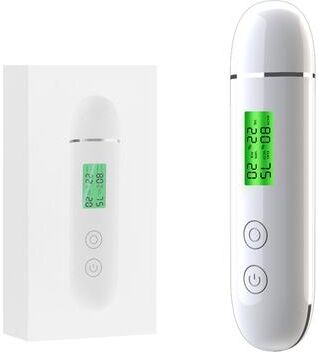
StayWell LCD Digital Skin Detector Pen Face Skin Tester, Smart Water Oil Fluorescent Content Facial Moisture Analyzer Skin Care LCD Digital Skin Detector Pen Face Skin Tester, Smart Water Oil Fluorescent Content Facial Moisture Analyzer Skin CareUnlock Your Best Skin Ever Experience precision skin analysis at home with the bold, clear LCD Digital Skin Detector Pen. No more guessingthis smart device measures moisture, oil balance, elasticity, and even detects harmful fluorescent agents in...44,97 $*Shipping: 0,00 $Secure redirect to the provider
-
What is the biserial correlation coefficient and the phi coefficient and the chi coefficient?
The biserial correlation coefficient is a measure of the strength and direction of the relationship between a continuous variable and a dichotomous variable. It is calculated when one variable is continuous and the other is dichotomous. The phi coefficient is a measure of association between two dichotomous variables. It is calculated using a 2x2 contingency table and ranges from -1 to 1, with 0 indicating no association and 1 indicating a perfect association. The chi coefficient is a measure of association between two dichotomous variables, similar to the phi coefficient. It is also calculated using a 2x2 contingency table and ranges from -1 to 1, with 0 indicating no association and 1 indicating a perfect association. **
-
Which correlation coefficient?
The correlation coefficient is a statistical measure that quantifies the strength and direction of a relationship between two variables. It ranges from -1 to 1, with -1 indicating a perfect negative correlation, 0 indicating no correlation, and 1 indicating a perfect positive correlation. The correlation coefficient is used to determine how closely the two variables are related and can help in making predictions or understanding the nature of the relationship between them. **
-
What is the binomial coefficient?
The binomial coefficient, denoted as ${n \choose k}$, represents the number of ways to choose k elements from a set of n elements without regard to the order of selection. It is calculated using the formula ${n \choose k} = \frac{n!}{k!(n-k)!}$, where n! denotes the factorial of n. The binomial coefficient is commonly used in combinatorics and probability theory to calculate the number of combinations or possibilities in a given scenario. **
-
What is the Lusor coefficient?
The Lusor coefficient is a measure of the ability of a fluid to carry sediment. It is used in the field of sediment transport to quantify the sediment-carrying capacity of a fluid, such as water or air. The coefficient takes into account factors such as the size and density of the sediment particles, as well as the velocity and viscosity of the fluid. A higher Lusor coefficient indicates a greater ability of the fluid to transport sediment. **
Similar search terms for Coefficient
-
What is the validity coefficient?
The validity coefficient is a statistical measure that quantifies the relationship between a predictor (such as a test or assessment) and a criterion (such as job performance or academic achievement). It indicates the degree to which the predictor is able to accurately predict the criterion. A higher validity coefficient suggests a stronger relationship between the predictor and the criterion, indicating that the predictor is more effective in predicting the criterion. Validity coefficients are commonly used in the field of psychometrics and are important for evaluating the effectiveness of selection tools and assessments. **
-
What is a Gini coefficient?
A Gini coefficient is a measure of income inequality within a population. It is calculated based on the distribution of income or wealth among individuals or households in a given country or region. The coefficient ranges from 0 to 1, with 0 representing perfect equality (everyone has the same income) and 1 representing perfect inequality (one person has all the income). A higher Gini coefficient indicates greater income inequality, while a lower coefficient indicates more equal distribution of income. **
-
What is the multiplication coefficient?
The multiplication coefficient is a number that represents the factor by which a quantity is multiplied. It is used to scale or increase the value of a quantity by a certain amount. For example, if the multiplication coefficient is 2, then the quantity is doubled. The multiplication coefficient is often used in mathematical equations and calculations to represent the relationship between different quantities. **
-
How is the Gini coefficient calculated?
The Gini coefficient is calculated by plotting the cumulative distribution of income or wealth against the cumulative share of the population. The coefficient is then derived by dividing the area between the line of perfect equality (where everyone has the same income or wealth) and the actual distribution curve by the total area under the line of perfect equality. The resulting value ranges from 0 (perfect equality) to 1 (perfect inequality). **
* All prices are inclusive of VAT and, if applicable, plus shipping costs. The offer information is based on the details provided by the respective shop and is updated through automated processes. Real-time updates do not occur, so deviations can occur in individual cases. ** Note: Parts of this content were created by AI.