Buy web-publishers.com ?
We are moving the project
web-publishers.com .
Are you interested in purchasing the domain
web-publishers.com ?
domain@kv-gmbh.de · 0541-91531010
Buy web-publishers.com ?
Why didn't Tolkien like Disney?
Tolkien didn't like Disney because he felt that the company's approach to storytelling and adaptation was too commercial and lacked the depth and seriousness of his own work. He was also concerned that Disney's adaptations would oversimplify and distort the themes and characters of his stories, which were deeply rooted in his own personal experiences and beliefs. Additionally, Tolkien was protective of his creative vision and wanted his work to be treated with the same level of respect and integrity that he had put into it. **
How many books did Tolkien write?
J.R.R. Tolkien wrote a total of 23 books during his lifetime. These include his famous works such as "The Hobbit," "The Lord of the Rings" trilogy, and "The Silmarillion," as well as various other essays, poems, and academic publications. Tolkien's books have had a lasting impact on the fantasy genre and continue to be beloved by readers around the world. **

Similar search terms for Tolkien
Top-Angebote
Products related to Tolkien:
-
The World of Tolkien by David Day Complete 6 Books Box Set - Fiction - Paperback HarperCollins PublishersTitles in This Set : 1. The Hobbits of Tolkien 2. The Dark Powers of Tolkien 3. The Heroes of Tolkien 4. Tolkien: An Illustrated Atlas 5. The Battles of Tolkien 6. A Dictionary of Tolkien Description : The Hobbits of Tolkien An entire race was born when J.R.R. Tolkien scrawled on a leaf, 'In a hole in the ground there lived a hobbit.' From the invention of that single word (hobbit) Tolkien became the explorer and chronicler of the character, their race and their significant role in his fantastical world, Middle-earth. The Dark Powers of Tolkien J.R.R. Tolkien's The Lord of the Rings, The Hobbit and The Silmarillion are some of the greatest tales of good versus evil ever told. From the creation of Arda to the War of the Ring, Tolkien's Middle-earth has seen war and rebellion, devastation and loss, in which the powers of darkness emerged. The Heroes of Tolkien R. R. Tolkien's fictional world of Middle-earth is filled with great heroes who rose in the face of crisis to shape the course of that world's history. This volume examines the complexities surrounding Tolkien's portrayal of good and evil, analyzing the most celebrated heroes from the earliest days of Arda to the end of the War of the Ring. Men, elves, dwarves, and their allies are covered in detail, and each hero's role in the battle against the forces of evil is discussed at length. Tolkien: An Illustrated Atlas This lavish colour atlas is a complete guide to the weird and wonderful geography of Tolkien's world. Packed with full page maps and illustration of events in the annals of Middle Earth, it is the perfect companion to the bestselling Tolkien: A Dictionary. The Battles of Tolkien Analyzes each battle in depth, with clear maps showing the lay of the land, and exactly how and where the armies attacked. This is essential reading for anyone who loves Tolkien's works and wants to explore the wars within them. The Heroes of Tolkien If you love The Lord of the Rings, The Hobbit or The Silmarillion (or knows someone who does) then this is the perfect companion to unearthing the history, influences and genius behind each title, and the beloved heroes they contain .J. R. R Tolkien's Middle-earth has endured cataclysmic wars and critical battles, causing great men and women to arise and shape the course of its history. A Dictionary of Tolkien Explores and explains the creatures, plants, events and places that make up these strange and wonderful lands. It is essential reading for anyone who loves Tolkien's works and wants to learn more about them. This book is unofficial and is not authorised by the Tolkien Estate or HarperCollins Publishers. The Battles of Tolkien Tolkien's works are punctuated by dramatic and explosive battles. Men versus Orcs, Elves versus Sauron, Goblins versus Dwarves - the history of Middle-earth has seen some of the greatest characters pitted against each other time and time again. From the iconic battle of Helm's Deep to the Destruction of Isengard.35,45 £*Shipping: 0,00 £Secure redirect to the provider
-
The First Age of Middle-earth by J.R.R. Tolkien 3 Books Collection Set - Fiction - Paperback HarperCollins PublishersGet ready for The Lord of the Rings: The Rings of Power with this three-book collection of the "great tales" of the First Age of Middle-earth. J. R. R. Tolkien wrote and revised these tales throughout his life, and these versions were completed after his death by his son Christopher. Before The Hobbit, before The Silmarillion, these are the original myths of Middle-earth. Titles in This Set: The Children of Hurin Beren and Luthien The Fall of Gondolin Description: The Children of Hurin It is a legendary time long before The Lord of the Rings, and Morgoth, the first Dark Lord, dwells in the vast fortress of Angband in the North; and within the shadow of the fear of Angband, and the war waged by Morgoth against the Elves, the fates of Túrin and his sister Niënor will be tragically entwined. Their brief and passionate lives are dominated by the elemental hatred that Morgoth bears them as the children of Húrin, the man who dared to defy him to his face. Against them Morgoth sends his most formidable servant, Glaurung, a powerful spirit in the form of a huge wingless dragon of fire, in an attempt to fulfil the curse of Morgoth, and destroy the children of Húrin. Beren and Luthien Essential to the story, and never changed, is the fate that shadowed the love of Beren and Lúthien: for Beren was a mortal man, but Lúthien was an immortal Elf. Her father, a great Elvish lord, in deep opposition to Beren, imposed on him an impossible task that he must perform before he might wed Lúthien. This is the kernel of the legend; and it leads to the supremely heroic attempt of Beren and Lúthien together to rob the greatest of all evil beings, Melkor, called Morgoth, the Black Enemy, of a Silmaril. In this book Christopher Tolkien has attempted to extract the story of Beren and Lúthien from the comprehensive work in which it was embedded; but that story was itself changing as it developed new associations within the larger history. To show something of the process whereby this legend of Middle-earth evolved over the years, he has told the story in his father's own words by giving, first, its original form, and then passages in prose and verse from later texts that illustrate the narrative as it changed. Presented together for the first time, they reveal aspects of the story, both in event and in narrative immediacy, that were afterwards lost. The Fall of Gondolin Gondolin, beautiful but undiscoverable, is central to the enmity of two of the greatest powers in the world. Morgoth of the uttermost evil seeks in vain to discover the marvellously hidden city of his Elven enemies, while the gods in Valinor refuse to support Ulmo, the Lord of Waters, and his designs to protect it. Into this world comes Tuor, cousin of Túrin, and guided unseen by Ulmo he sets out on the fearful journey to Gondolin to warn them of their coming doom. Then Morgoth learns through an act of supreme treachery all that he needs to mount a devastating attack on the city, with Balrogs and dragons and...25,99 £*Shipping: 2,99 £Secure redirect to the provider
-
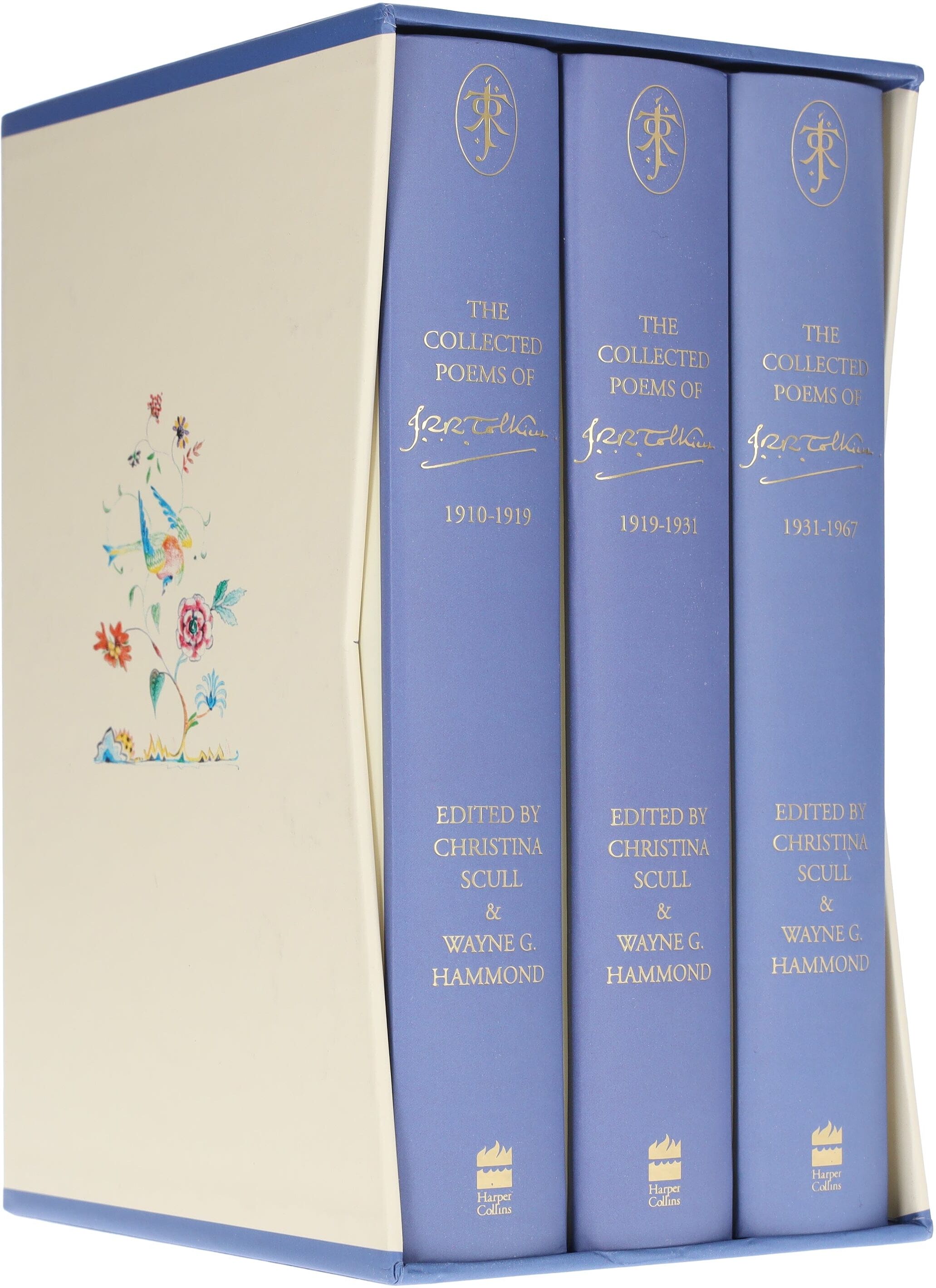
The Collected Poems of J. R. R. Tolkien: 3 Books Collection Box Set - Non-Fiction - Hardback HarperCollins PublishersWorld first publication of the collected poems of J.R.R. Tolkien, spanning almost seven decades of the author’s life and presented in an elegant three-volume hardback boxed set. J.R.R. Tolkien aspired to be a poet in the first instance, and poetry was part of his creative life no less than his prose, his languages, and his art. Although Tolkien’s readers are aware that he wrote poetry, if only from verses in The Hobbit and The Lord of the Rings, its extent is not well known, and its qualities are underappreciated. Within his larger works of fiction, poems help to establish character and place as well as further the story; as individual works, they delight with words and rhyme. They express his love of nature and the seasons, of landscape and music, and of words. They convey his humour and his sense of wonder. The earliest work in this collection, written for his beloved, is dated to 1910, when Tolkien was eighteen. More poems would follow during his years at Oxford, some of them very elaborate and eccentric. Those he composed during the First World War, in which he served in France, tend to be concerned not with trenches and battle, but with life, loss, faith, and friendship, his longing for England, and the wife he left behind. Beginning in 1914, elements of his legendarium, ‘The Silmarillion’, began to appear, and the ‘Matter of Middle-earth’ would inspire much of Tolkien’s verse for the rest of his life. Within The Collected Poems of J.R.R. Tolkien almost 250 works are presented across three volumes, including more than 70 that have never before been seen. The poems are deftly woven together with commentary and notes by world-renowned Tolkien scholars Christina Scull & Wayne G. Hammond, placing them in the context of Tolkien’s life and literary accomplishments and creating a poetical biography that is a unique and revealing celebration of J.R.R. Tolkien.58,85 £*Shipping: 0,00 £Secure redirect to the provider


-
Why didn't J.R.R. Tolkien like the Germans?
J.R.R. Tolkien did not have a personal dislike for Germans as a whole. However, he did have negative feelings towards the German Nazi regime and its ideology, particularly due to their promotion of racial purity and their aggressive expansionist policies during World War II. Tolkien's own experiences fighting in World War I and witnessing the devastation caused by war may have also influenced his views on militarism and totalitarianism. **
-
In what order are the Tolkien books?
The order of the main books in J.R.R. Tolkien's Middle-earth legendarium is as follows: "The Hobbit," "The Lord of the Rings" trilogy (which consists of "The Fellowship of the Ring," "The Two Towers," and "The Return of the King"), and "The Silmarillion." While "The Hobbit" is a standalone story, "The Lord of the Rings" trilogy follows a continuous narrative and should be read in order. "The Silmarillion" provides a deeper dive into the history and mythology of Middle-earth. **
-
What are the names of J.R.R. Tolkien?
J.R.R. Tolkien's full name is John Ronald Reuel Tolkien. He was born on January 3, 1892, in Bloemfontein, South Africa. He was an English writer, poet, philologist, and university professor, best known as the author of the classic high fantasy works "The Hobbit," "The Lord of the Rings," and "The Silmarillion." **
-
What is the order of the Tolkien books?
The order of the main Tolkien books is as follows: 1. "The Hobbit" - a prelude to "The Lord of the Rings" series. 2. "The Lord of the Rings" series, consisting of three books: - "The Fellowship of the Ring" - "The Two Towers" - "The Return of the King" 3. "The Silmarillion" - a collection of mythopoeic works that delve into the history and mythology of Middle-earth. 4. Other works such as "The Children of Húrin," "Unfinished Tales," and "The History of Middle-earth" series provide additional insights into Tolkien's legendarium. **

Which books by J.R.R. Tolkien are the best translation?
The best translations of J.R.R. Tolkien's works are often considered to be those that stay true to the original text while capturing the essence and tone of his writing. Some popular translations include those in French by Daniel Lauzon, in Spanish by Rubén Masera, and in German by Wolfgang Krege. These translations are praised for their attention to detail and ability to convey the rich world-building and intricate storytelling of Tolkien's works. Ultimately, the best translation may vary depending on individual preferences and language proficiency. **
Does Tolkien mention anywhere that Elves have long hair?
Yes, Tolkien does mention that Elves have long hair in his writings. In "The Silmarillion," he describes the Elves as having long, flowing hair that is often described as shining or radiant. Additionally, in "The Lord of the Rings," Legolas, a prominent Elf character, is described as having long golden hair. Overall, Tolkien's portrayal of Elves consistently includes the characteristic of long hair. **
Top-Angebote
Products related to Tolkien:
-
Tales of Middle-Earth By J.R.R. Tolkien 5 Books Collection Set - Fiction - Paperback HarperCollins PublishersThis five-book collection is the perfect preparation for The Lord of the Rings: The Rings of Power. In 1917, long before he wrote The Hobbit, J.R.R. Tolkien laid the groundwork for his legendarium. These myths and legends were woven into The Lord of the Rings to evoke a deep history. His son Christopher Tolkien edited and published these tales of Middle-earth for its legions of fans and admirers. This collection starts with The Silmarillion (1977). The first section is a creation narrative, and the second describes the Valar and the main enemy, Melkor. The third and largest section, Quenta Silmarillion, tells of the First Age of Middle-Earth and the tragic saga of the Silmarils, three jewels containing the light of creation. The fourth section, Akallabêth, details the fall of the great island kingdom Numenor in the Second Age, and the fifth and final section places the events of The Lord of the Rings into this narrative. Unfinished Tales (1980) contains new text alongside alternate versions of tales in The Silmarillion, presented as Tolkien left them before his death. After completing the ambitious and comprehensive The History of Middle-earth in 12 volumes, Christopher Tolkien returned to the First Age to present three of its stories as standalone novels: The Children of Hurin, Beren and Luthien and The Fall of Gondolin. This set is perfect for the fantasy obsessive who wants to explore the narratives behind its greatest work. Grab this great value collection today, and learn of the dignity of elves, the frailty of man, and the rising of great evil. Titles in This Set: The Silmarillion Unfinished Tales The Children of Hurin Beren and Luthien The Fall of Gondolin Description: The Silmarillion The Silmarillion is an account of the Elder Days, of the First Age of Tolkien’s world. It is the ancient drama to which the characters in The Lord of the Rings look back, and in whose events some of them such as Elrond and Galadriel took part. The tales of The Silmarillion are set in an age when Morgoth, the first Dark Lord, dwelt in Middle-Earth, and the High Elves made war upon him for the recovery of the Silmarils, the jewels containing the pure light of Valinor. Unfinished Tales The book concentrates on the realm of Middle-earth and comprises such elements as Gandalf’s lively account of how it was that he came to send the Dwarves to the celebrated party at Bag-End, the emergence of the sea-god Ulmo before the eyes of Tuor on the coast of Beleriand, and an exact description of the military organization of the Riders of Rohan. Unfinished Tales also contains the only story about the long ages of Numenor before its downfall, and all that is known about such matters as the Five Wizards, the Palantiri and the legend of Amroth. The tales were collated and edited by JRR Tolkien’s son and literary heir, Christopher Tolkien, who provides a short commentary on each story, helping the reader to fill in the gaps and put each story into the context of the rest of his...32,99 £*Shipping: 2,99 £Secure redirect to the provider
-
The World of Tolkien by David Day Complete 6 Books Box Set - Fiction - Paperback HarperCollins PublishersTitles in This Set : 1. The Hobbits of Tolkien 2. The Dark Powers of Tolkien 3. The Heroes of Tolkien 4. Tolkien: An Illustrated Atlas 5. The Battles of Tolkien 6. A Dictionary of Tolkien Description : The Hobbits of Tolkien An entire race was born when J.R.R. Tolkien scrawled on a leaf, 'In a hole in the ground there lived a hobbit.' From the invention of that single word (hobbit) Tolkien became the explorer and chronicler of the character, their race and their significant role in his fantastical world, Middle-earth. The Dark Powers of Tolkien J.R.R. Tolkien's The Lord of the Rings, The Hobbit and The Silmarillion are some of the greatest tales of good versus evil ever told. From the creation of Arda to the War of the Ring, Tolkien's Middle-earth has seen war and rebellion, devastation and loss, in which the powers of darkness emerged. The Heroes of Tolkien R. R. Tolkien's fictional world of Middle-earth is filled with great heroes who rose in the face of crisis to shape the course of that world's history. This volume examines the complexities surrounding Tolkien's portrayal of good and evil, analyzing the most celebrated heroes from the earliest days of Arda to the end of the War of the Ring. Men, elves, dwarves, and their allies are covered in detail, and each hero's role in the battle against the forces of evil is discussed at length. Tolkien: An Illustrated Atlas This lavish colour atlas is a complete guide to the weird and wonderful geography of Tolkien's world. Packed with full page maps and illustration of events in the annals of Middle Earth, it is the perfect companion to the bestselling Tolkien: A Dictionary. The Battles of Tolkien Analyzes each battle in depth, with clear maps showing the lay of the land, and exactly how and where the armies attacked. This is essential reading for anyone who loves Tolkien's works and wants to explore the wars within them. The Heroes of Tolkien If you love The Lord of the Rings, The Hobbit or The Silmarillion (or knows someone who does) then this is the perfect companion to unearthing the history, influences and genius behind each title, and the beloved heroes they contain .J. R. R Tolkien's Middle-earth has endured cataclysmic wars and critical battles, causing great men and women to arise and shape the course of its history. A Dictionary of Tolkien Explores and explains the creatures, plants, events and places that make up these strange and wonderful lands. It is essential reading for anyone who loves Tolkien's works and wants to learn more about them. This book is unofficial and is not authorised by the Tolkien Estate or HarperCollins Publishers. The Battles of Tolkien Tolkien's works are punctuated by dramatic and explosive battles. Men versus Orcs, Elves versus Sauron, Goblins versus Dwarves - the history of Middle-earth has seen some of the greatest characters pitted against each other time and time again. From the iconic battle of Helm's Deep to the Destruction of Isengard.35,45 £*Shipping: 0,00 £Secure redirect to the provider
-
The First Age of Middle-earth by J.R.R. Tolkien 3 Books Collection Set - Fiction - Paperback HarperCollins PublishersGet ready for The Lord of the Rings: The Rings of Power with this three-book collection of the "great tales" of the First Age of Middle-earth. J. R. R. Tolkien wrote and revised these tales throughout his life, and these versions were completed after his death by his son Christopher. Before The Hobbit, before The Silmarillion, these are the original myths of Middle-earth. Titles in This Set: The Children of Hurin Beren and Luthien The Fall of Gondolin Description: The Children of Hurin It is a legendary time long before The Lord of the Rings, and Morgoth, the first Dark Lord, dwells in the vast fortress of Angband in the North; and within the shadow of the fear of Angband, and the war waged by Morgoth against the Elves, the fates of Túrin and his sister Niënor will be tragically entwined. Their brief and passionate lives are dominated by the elemental hatred that Morgoth bears them as the children of Húrin, the man who dared to defy him to his face. Against them Morgoth sends his most formidable servant, Glaurung, a powerful spirit in the form of a huge wingless dragon of fire, in an attempt to fulfil the curse of Morgoth, and destroy the children of Húrin. Beren and Luthien Essential to the story, and never changed, is the fate that shadowed the love of Beren and Lúthien: for Beren was a mortal man, but Lúthien was an immortal Elf. Her father, a great Elvish lord, in deep opposition to Beren, imposed on him an impossible task that he must perform before he might wed Lúthien. This is the kernel of the legend; and it leads to the supremely heroic attempt of Beren and Lúthien together to rob the greatest of all evil beings, Melkor, called Morgoth, the Black Enemy, of a Silmaril. In this book Christopher Tolkien has attempted to extract the story of Beren and Lúthien from the comprehensive work in which it was embedded; but that story was itself changing as it developed new associations within the larger history. To show something of the process whereby this legend of Middle-earth evolved over the years, he has told the story in his father's own words by giving, first, its original form, and then passages in prose and verse from later texts that illustrate the narrative as it changed. Presented together for the first time, they reveal aspects of the story, both in event and in narrative immediacy, that were afterwards lost. The Fall of Gondolin Gondolin, beautiful but undiscoverable, is central to the enmity of two of the greatest powers in the world. Morgoth of the uttermost evil seeks in vain to discover the marvellously hidden city of his Elven enemies, while the gods in Valinor refuse to support Ulmo, the Lord of Waters, and his designs to protect it. Into this world comes Tuor, cousin of Túrin, and guided unseen by Ulmo he sets out on the fearful journey to Gondolin to warn them of their coming doom. Then Morgoth learns through an act of supreme treachery all that he needs to mount a devastating attack on the city, with Balrogs and dragons and...25,99 £*Shipping: 2,99 £Secure redirect to the provider
-
Why didn't Tolkien like Disney?
Tolkien didn't like Disney because he felt that the company's approach to storytelling and adaptation was too commercial and lacked the depth and seriousness of his own work. He was also concerned that Disney's adaptations would oversimplify and distort the themes and characters of his stories, which were deeply rooted in his own personal experiences and beliefs. Additionally, Tolkien was protective of his creative vision and wanted his work to be treated with the same level of respect and integrity that he had put into it. **
-
How many books did Tolkien write?
J.R.R. Tolkien wrote a total of 23 books during his lifetime. These include his famous works such as "The Hobbit," "The Lord of the Rings" trilogy, and "The Silmarillion," as well as various other essays, poems, and academic publications. Tolkien's books have had a lasting impact on the fantasy genre and continue to be beloved by readers around the world. **
-
Why didn't J.R.R. Tolkien like the Germans?
J.R.R. Tolkien did not have a personal dislike for Germans as a whole. However, he did have negative feelings towards the German Nazi regime and its ideology, particularly due to their promotion of racial purity and their aggressive expansionist policies during World War II. Tolkien's own experiences fighting in World War I and witnessing the devastation caused by war may have also influenced his views on militarism and totalitarianism. **
-
In what order are the Tolkien books?
The order of the main books in J.R.R. Tolkien's Middle-earth legendarium is as follows: "The Hobbit," "The Lord of the Rings" trilogy (which consists of "The Fellowship of the Ring," "The Two Towers," and "The Return of the King"), and "The Silmarillion." While "The Hobbit" is a standalone story, "The Lord of the Rings" trilogy follows a continuous narrative and should be read in order. "The Silmarillion" provides a deeper dive into the history and mythology of Middle-earth. **
Similar search terms for Tolkien
-
The Collected Poems of J. R. R. Tolkien: 3 Books Collection Box Set - Non-Fiction - Hardback HarperCollins PublishersWorld first publication of the collected poems of J.R.R. Tolkien, spanning almost seven decades of the author’s life and presented in an elegant three-volume hardback boxed set. J.R.R. Tolkien aspired to be a poet in the first instance, and poetry was part of his creative life no less than his prose, his languages, and his art. Although Tolkien’s readers are aware that he wrote poetry, if only from verses in The Hobbit and The Lord of the Rings, its extent is not well known, and its qualities are underappreciated. Within his larger works of fiction, poems help to establish character and place as well as further the story; as individual works, they delight with words and rhyme. They express his love of nature and the seasons, of landscape and music, and of words. They convey his humour and his sense of wonder. The earliest work in this collection, written for his beloved, is dated to 1910, when Tolkien was eighteen. More poems would follow during his years at Oxford, some of them very elaborate and eccentric. Those he composed during the First World War, in which he served in France, tend to be concerned not with trenches and battle, but with life, loss, faith, and friendship, his longing for England, and the wife he left behind. Beginning in 1914, elements of his legendarium, ‘The Silmarillion’, began to appear, and the ‘Matter of Middle-earth’ would inspire much of Tolkien’s verse for the rest of his life. Within The Collected Poems of J.R.R. Tolkien almost 250 works are presented across three volumes, including more than 70 that have never before been seen. The poems are deftly woven together with commentary and notes by world-renowned Tolkien scholars Christina Scull & Wayne G. Hammond, placing them in the context of Tolkien’s life and literary accomplishments and creating a poetical biography that is a unique and revealing celebration of J.R.R. Tolkien.58,85 £*Shipping: 0,00 £Secure redirect to the provider
-
What are the names of J.R.R. Tolkien?
J.R.R. Tolkien's full name is John Ronald Reuel Tolkien. He was born on January 3, 1892, in Bloemfontein, South Africa. He was an English writer, poet, philologist, and university professor, best known as the author of the classic high fantasy works "The Hobbit," "The Lord of the Rings," and "The Silmarillion." **
-
What is the order of the Tolkien books?
The order of the main Tolkien books is as follows: 1. "The Hobbit" - a prelude to "The Lord of the Rings" series. 2. "The Lord of the Rings" series, consisting of three books: - "The Fellowship of the Ring" - "The Two Towers" - "The Return of the King" 3. "The Silmarillion" - a collection of mythopoeic works that delve into the history and mythology of Middle-earth. 4. Other works such as "The Children of Húrin," "Unfinished Tales," and "The History of Middle-earth" series provide additional insights into Tolkien's legendarium. **
-
Which books by J.R.R. Tolkien are the best translation?
The best translations of J.R.R. Tolkien's works are often considered to be those that stay true to the original text while capturing the essence and tone of his writing. Some popular translations include those in French by Daniel Lauzon, in Spanish by Rubén Masera, and in German by Wolfgang Krege. These translations are praised for their attention to detail and ability to convey the rich world-building and intricate storytelling of Tolkien's works. Ultimately, the best translation may vary depending on individual preferences and language proficiency. **
-
Does Tolkien mention anywhere that Elves have long hair?
Yes, Tolkien does mention that Elves have long hair in his writings. In "The Silmarillion," he describes the Elves as having long, flowing hair that is often described as shining or radiant. Additionally, in "The Lord of the Rings," Legolas, a prominent Elf character, is described as having long golden hair. Overall, Tolkien's portrayal of Elves consistently includes the characteristic of long hair. **
* All prices are inclusive of VAT and, if applicable, plus shipping costs. The offer information is based on the details provided by the respective shop and is updated through automated processes. Real-time updates do not occur, so deviations can occur in individual cases. ** Note: Parts of this content were created by AI.